

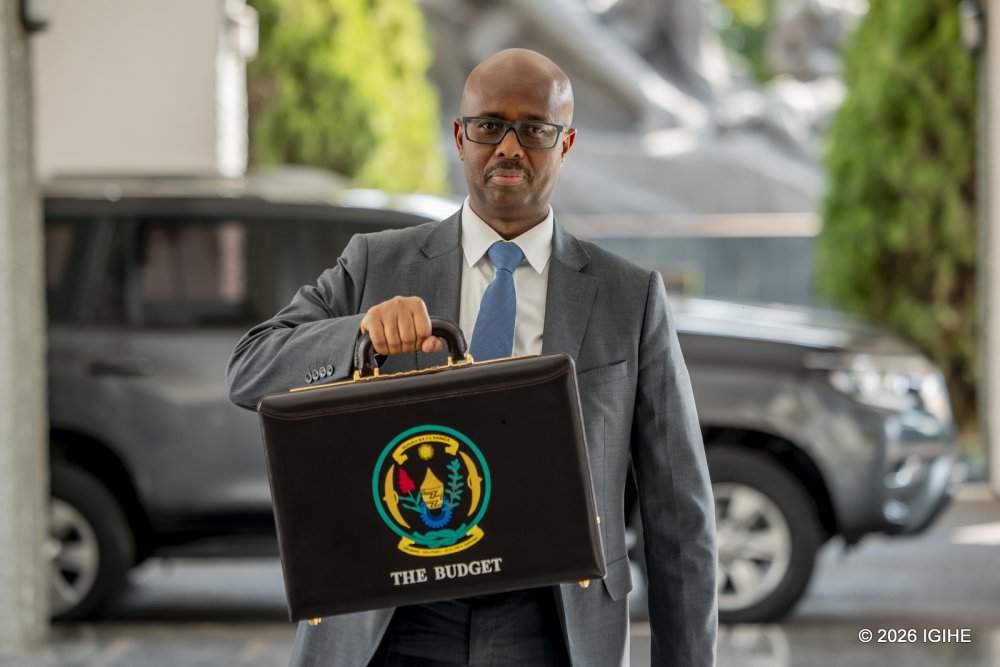
The budget law was passed during a plenary sitting attended by 63 lawmakers on June 24, following the initial presentation by the Minister of Finance and Economic Planning, Yusuf Murangwa.
The approved budget represents a 12% increase from the revised 2025/26 budget approved in February, which stood at Rwf 6,952.1 billion. Total government spending is set to rise by roughly Rwf 844.2 billion to hit the new Rwf 7.796 trillion ceiling.
According to Parliament's Budget Committee Chairperson, Odette Uwamariya, the financing structure reflects Rwanda's solid path toward economic self-reliance. Total domestic resources, consisting of tax and non-tax revenues, will cover 64.3% of the entire budget envelope. When combined with domestic borrowing, internal financing funds 67.7% of national expenditure, meaning that roughly 68% of the budget is self-funded, while external loans and grants cover the remaining 32%.
In the finalized financing breakdown, tax revenues will contribute 56.8% of the total budget, while non-tax revenues will account for 7.5%. External borrowing through foreign loans is projected to provide 25.3% of the funding, while foreign grants will cover 7.0%. The remaining 3.4% of the budget will be financed through domestic borrowing.
Unlike earlier draft iterations, the finalized budget prioritizes robust operational and strategic execution across public institutions by dividing expenditure clearly between day-to-day costs and capital investments.
The recurrent budget, which covers operational costs and civil service salaries, has been set at Rwf 4,785.5 billion, representing 61.4% of total expenditure. The development budget, which is dedicated to public and capital infrastructure projects, stands at Rwf 3,010.8 billion, equivalent to 38.6% of the total envelope.
The spending structure closely aligns with the strategic pillars of the Second National Strategy for Transformation. The Economic Transformation Pillar receives the largest share, totaling Rwf 4,900.9 billion, or 63% of the entire budget. Under this pillar, priorities include boosting inclusive growth in agriculture and livestock production, promoting local industrialization, expanding electricity and clean water access, strengthening climate resilience, and creating decent jobs.
The Social Transformation Pillar has been allocated Rwf 1,711.3 billion, representing 22% of the budget. Funding in this segment will focus on improving education quality, upgrading healthcare infrastructure, expanding early childhood development centers to combat malnutrition, and supporting social protection programs to lift vulnerable households out of poverty.
The Transformational Governance Pillar has been allocated Rwf 1,184.0 billion, which accounts for the remaining 15% of the spending. This allocation will prioritize improving public service delivery, strengthening public financial management, promoting justice and the rule of law, and safeguarding national peace and security.
Committee Chairperson Uwamariya noted that while Rwanda's budget expands annually, public development needs are growing rapidly as the country pursues ambitious socioeconomic targets. Following rigorous institutional consultations, Parliament reallocated approximately Rwf 400 billion from lower-priority operational areas to urgent public programs.
As part of these parliamentary adjustments, agriculture and livestock support received a crucial supplementary boost of Rwf 3.08 billion to finalize its core footprint. A major win in this sector allocation is the substantial expansion of agricultural fertilizer subsidies, which nearly doubled from Rwf 39 billion in the previous fiscal year to Rwf 64 billion to counter rising costs on international markets. Funding for social protection safety nets targeting vulnerable populations was also increased by Rwf 4.3 billion to secure a stronger social support floor.
The transport sector's immediate development allocation for the 2026/27 fiscal year adjusted to Rwf 305.3 billion. This localized reduction reflects the successful completion of several major infrastructure projects alongside strategic transitions toward new investments. Despite this short-term consolidation, medium-term expenditure projections indicate aggressive growth in infrastructure spending.
Transport networks are slated to scale up with planned increases of Rwf 83.8 billion in the 2027/28 fiscal year and Rwf 92.6 billion in the 2028/29 fiscal year to fund key arterial links, feeder roads, and logistics infrastructure supporting the new Bugesera International Airport.
Source : https://new.igihe.com/english/rwandas-parliament-approves-rwf-7-8-trillion-budget/
