
Since tensions between the Democratic Republic of Congo (DRC) and Rwanda escalated in 2022, the two leaders have drawn closer politically and militarily. However, observers note that their cooperation appears to prioritise security and battlefield coordination over development initiatives such as infrastructure or economic integration.
At the centre of this alignment is the war in eastern DRC, where Burundian forces have become one of Kinshasa's key allies in operations against AFC/M23 and MRDP-Twirwaneho.
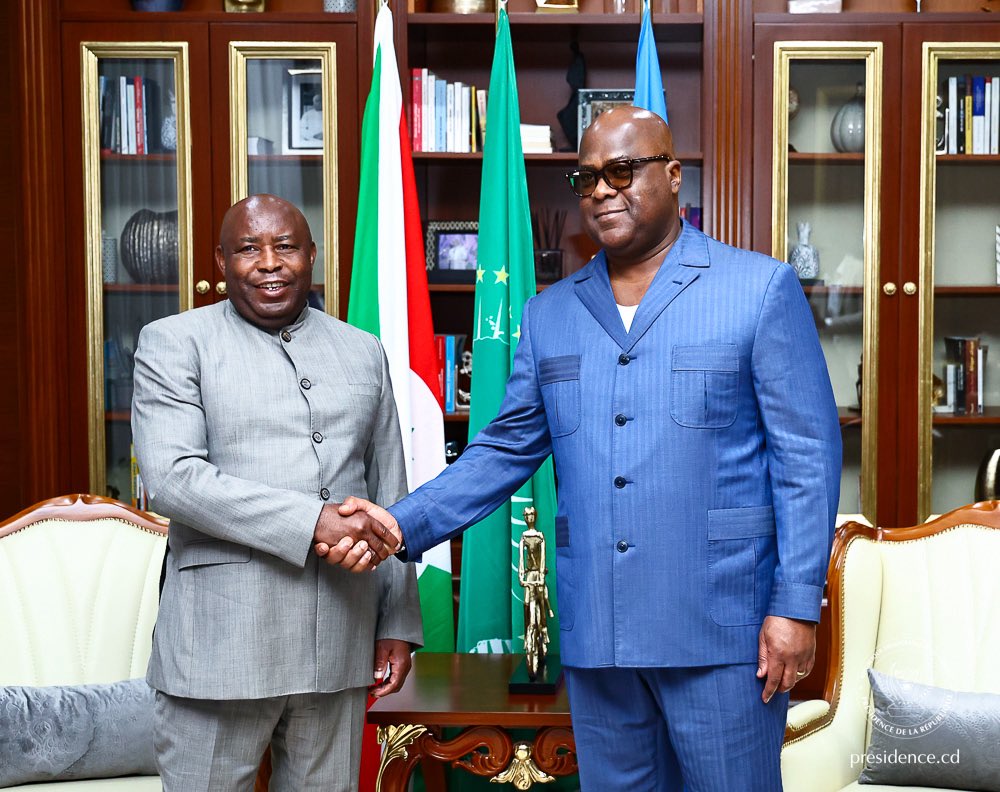
It is in this context that President Ndayishimiye arrived in Kinshasa for a two-day official visit beginning June 22, 2026, accompanied by his wife.
Official agenda versus underlying priorities
Publicly, discussions are said to focus on security in eastern DRC, bilateral cooperation, Ebola response, and broader regional issues. However, analysts argue that the real agenda extends far beyond these stated priorities.
The visit takes place as Burundian troops have remained deployed in the DRC for nearly three years, and as fighting in South Kivu, particularly in the Minembwe highlands, has intensified.
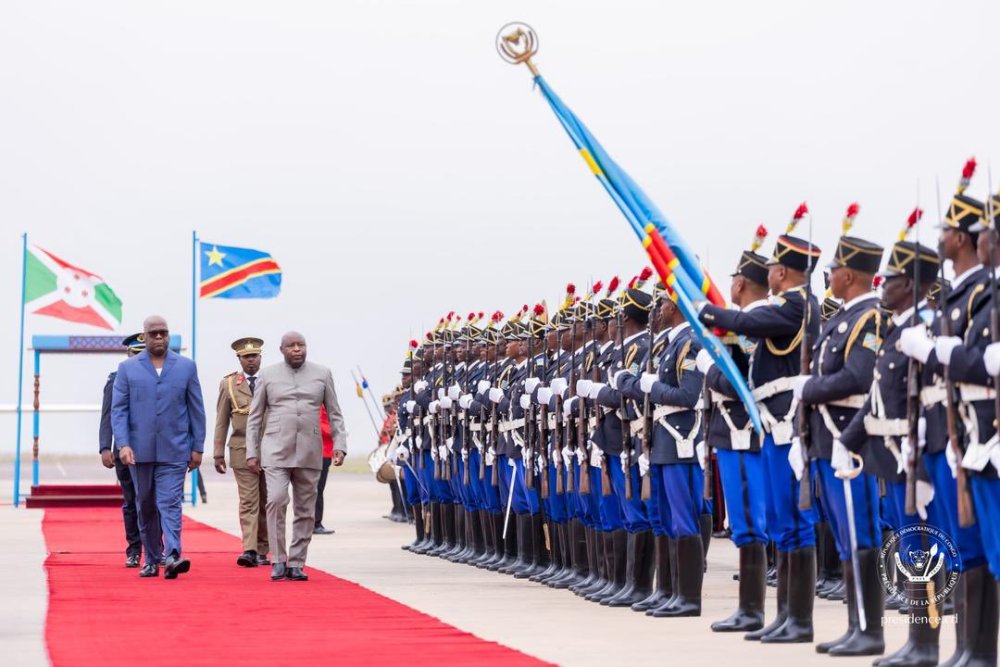
Tshisekedi personally received Ndayishimiye at N'djili International Airport, where the two leaders walked on a red carpet, national anthems were played, and military honours were rendered.
Later, they held closed-door talks at the Cité de l'Union Africaine. The ceremony projected strong bilateral ties, but also underscored deeper strategic alignments behind the scenes.
'Kinshasa views Bujumbura as its closest partner in both the military campaign and the political confrontation with Kigali. Burundi has effectively become a key operational instrument,' one analyst noted.
Congolese media similarly reported that the visit reflects coordination between two governments aligned around the objective of defending DRC sovereignty and countering Rwanda and AFC/M23.
A partnership defined by war rather than development
Since 2022, when relations between Rwanda and the DRC sharply deteriorated, high-level exchanges between Tshisekedi and Ndayishimiye have significantly increased.
Ndayishimiye has visited Kinshasa eight times, while Tshisekedi has made five visits to Burundi.
Military cooperation between the Burundian army and the FARDC began in South Kivu in 2022 and later expanded into operations in North Kivu against M23.
This shift followed Kinshasa's criticism of the East African Community (EAC) regional force, which it accused of failing to take an offensive stance against M23, instead focusing on separation of forces and ceasefire monitoring.
Since then, Tshisekedi has increasingly relied on partners willing to engage directly in combat operations, with Burundi emerging as a central ally.
Visit coincides with intensified fighting in Minembwe
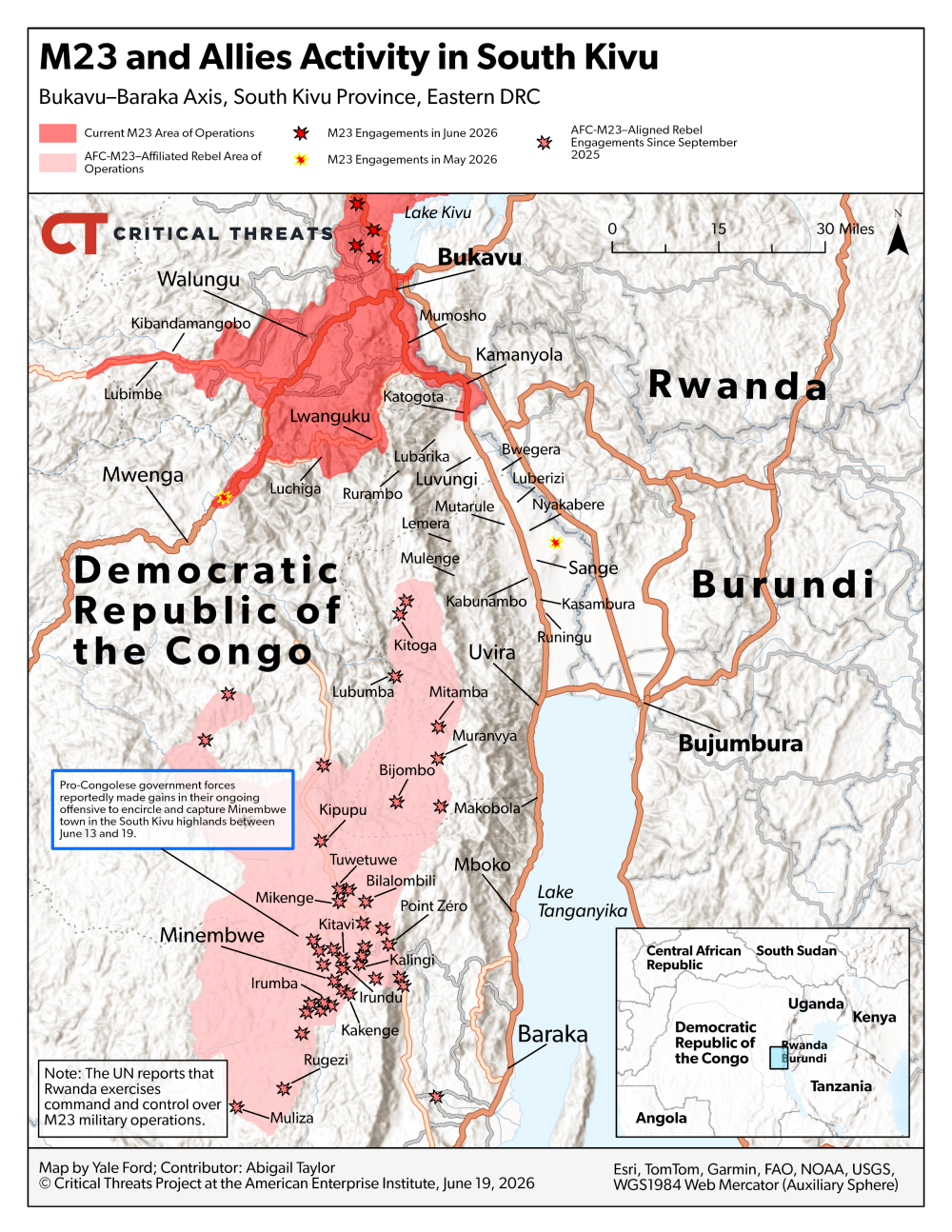
The visit comes amid ongoing and intense fighting in Minembwe, in South Kivu's highlands. Forces aligned with the DRC government have launched operations aimed at capturing Minembwe, engaging MRDP-Twirwaneho positions.
Between June 6 and 12, government forces reported capturing several villages around Minembwe. On June 13 and 14, reports indicated continued airstrikes on at least four surrounding villages.
Heavy artillery, aircraft, and drones were reportedly used. On June 15, Kinshasa announced that Minembwe had been taken, a claim rejected by MRDP-Twirwaneho.
On June 17, FARDC spokesperson in South Kivu, Lt. Reagan Mbuyi Kalonji, stated that government forces had seized villages including Ilundu, Kitavi, and Bidegu, and were advancing toward Minembwe airport.
Meanwhile, reports indicate that a DRC coalition aircraft, possibly an L-39, had been shot down, indicating escalation to a higher-intensity phase of combat.
Allegations of multi-force alignment in Minembwe
The situation in Minembwe highlights reported coordination among FARDC, Burundian forces, Wazalendo militias, and the FDLR. This reinforces long-standing accusations by Rwanda that the FDLR continues to operate alongside state and allied forces in eastern DRC.
Rwanda maintains that the FDLR, linked to perpetrators of the 1994 Genocide against the Tutsi, poses an ongoing security threat and should not be integrated into any legitimate security framework in the region.
On June 18 and 19, fighting continued. Reports from Kinshasa indicated that government forces carried out drone strikes using Turkish-made TB2 drones targeting Minembwe and surrounding areas.
However, MRDP-Twirwaneho maintained that it still controlled Minembwe, arguing that government forces had failed to secure full control over the strategically located territory linking Uvira, Fizi, and Mwenga.
Ndayishimiye's framing of the conflict
In an interview with Jeune Afrique, President Ndayishimiye described the conflict in eastern DRC as a direct security concern for Burundi.
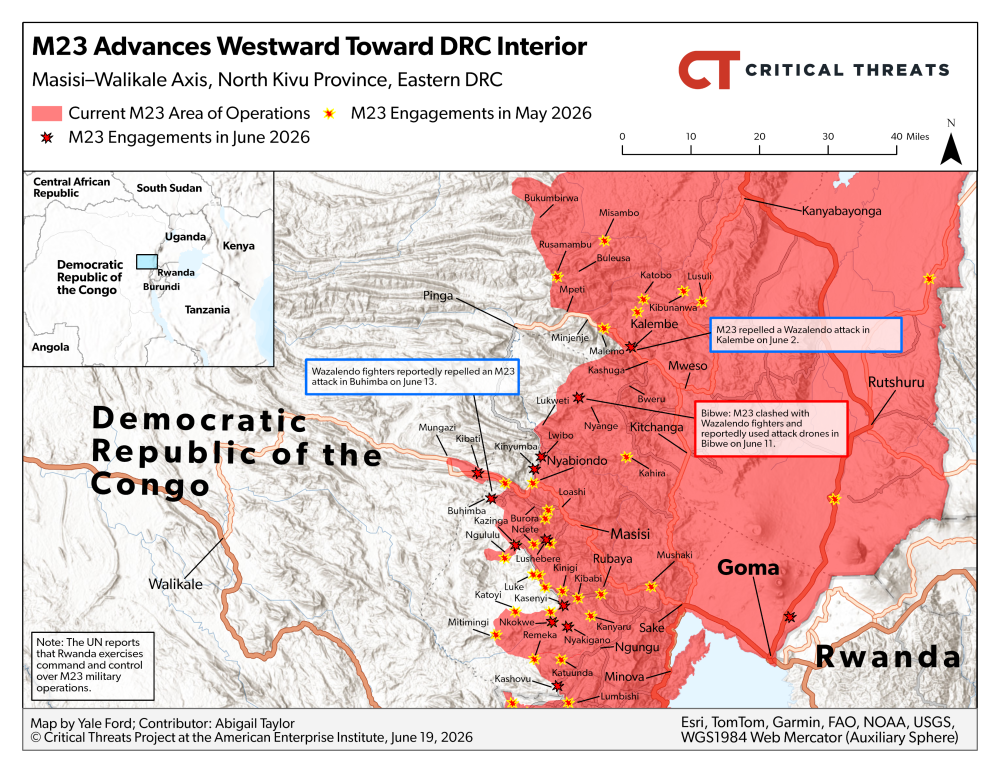
He referred to Uvira, a city close to Bujumbura, that was captured by AFC/M23 on December 10, 2025, shortly after the Washington peace agreement was signed between Tshisekedi and President Paul Kagame.
According to Ndayishimiye, M23's proximity to Burundi's border increases the risk of activation of the RED-Tabara rebel group against Burundi.
'As long as M23 fighters are near our border, it remains a problem, and we must remain vigilant,' he stated.
The city remained under AFC/M23 control for nearly a month before the group withdrew to allow renewed peace negotiations.
Burundian forces and questions over operational control
'We are not in the DRC to protect Burundi; we are there to support the Congolese army in its fight against its enemy,' Ndayishimiye stated.
He further noted that Burundian troops operate under FARDC command and are deployed according to Congolese military needs. He also emphasised that their withdrawal is solely the decision of the Congolese government.
'It is the Congolese government that must decide. If it finds their presence no longer useful, Burundi will withdraw its soldiers.'
While military cooperation between states is common, analysts note that the current arrangement raises questions about command structure and operational independence, with some describing it as unusually dependent on the host government's direction.
FDLR as a persistent regional fault line
Rwanda maintains that sustainable peace in eastern DRC is impossible as long as the FDLR remains active, tolerated, or insufficiently dismantled.
President Paul Kagame has repeatedly argued that Rwanda cannot be portrayed as the central security problem while armed groups hostile to Rwanda remain operational near its borders.
FDLR continues to be cited by Kigali as a key destabilising force in the region and as part of the broader conflict dynamics involving M23.
In broader geopolitical terms, the Tshisekedi–Ndayishimiye partnership increasingly appears anchored in a shared adversarial stance toward Rwanda.
For Kinshasa, the objective has been to build alliances with actors willing to support its military strategy against armed groups it associates with Rwanda. Tshisekedi has publicly signalled such intent since late 2023.
This position was further reinforced during Ndayishimiye's visit to Kinshasa in January 2024, when he was reported to have expressed support for mobilising Rwandan youth against their government.
'Every state has the right to choose its partners. The DRC can cooperate with Burundi, just as Burundi can cooperate with the DRC. However, when such cooperation involves armed groups, inflammatory rhetoric, and the neglect of the FDLR issue, it becomes a serious concern,' a regional analyst told IGIHE.