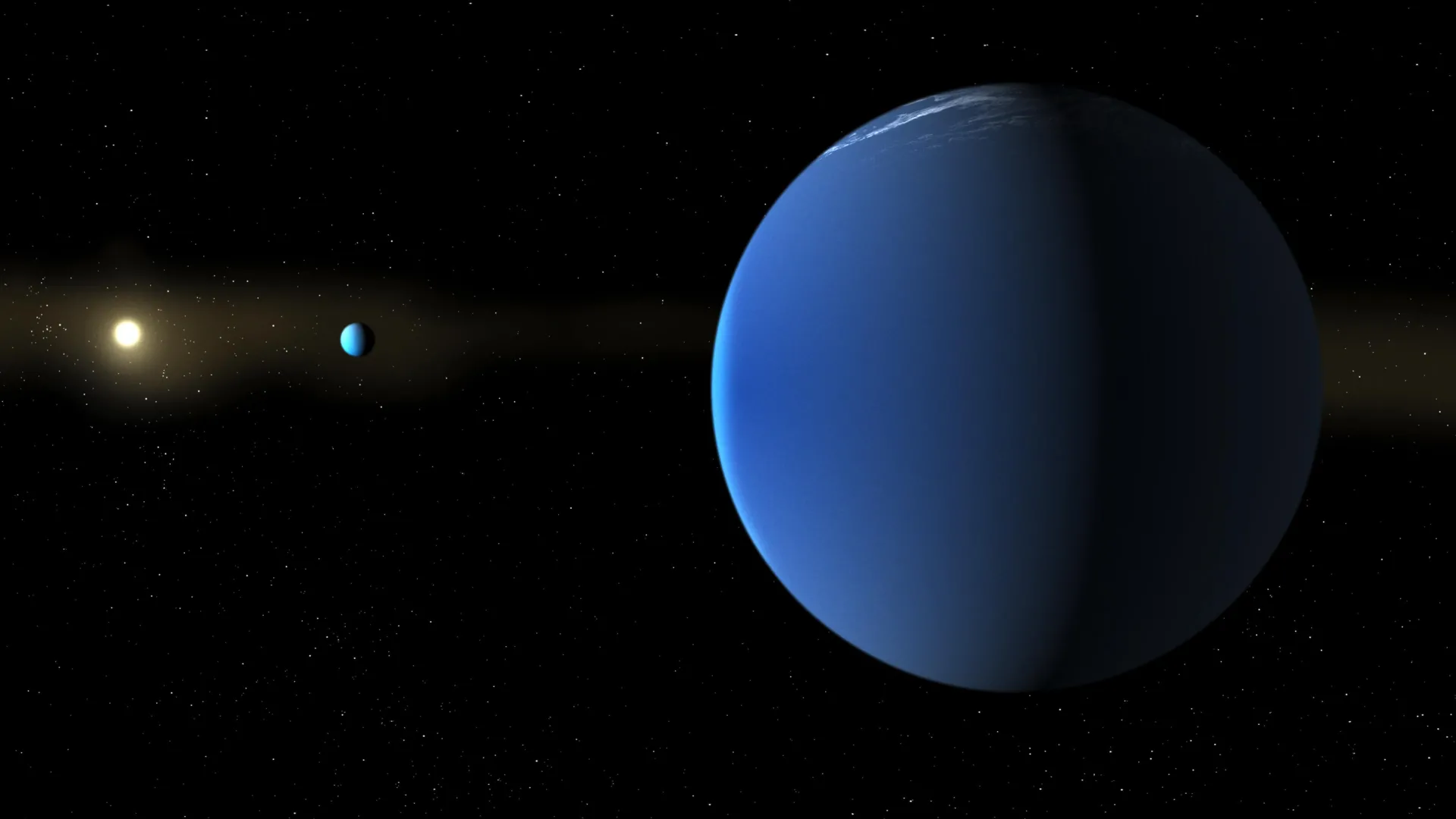

The groundbreaking discovery, announced on June 24, 2026, was made by an international research team led by the University of Oxford in collaboration with the University of Birmingham and the Observatoire de la Côte d'Azur. The team's formal findings were published in the journal Monthly Notices of the Royal Astronomical Society.
The two planets, known as TOI-791 b and TOI-791 c, orbit a distant F7-type dwarf star located around 1,110 light-years from Earth in the southern constellation Volans.
While an F7-type dwarf star is slightly hotter and more massive than the Sun, scientists believe these planets actually retain a cold, pristine structure. They likely formed far out in the chilly outer fringes of their protoplanetary disc, allowing them to rapidly accumulate massive gaseous envelopes without being scorched or stripped away early on.
Although both planets are similar in size to Jupiter, their masses are incredibly small. TOI-791 b contains just 3% of Jupiter's mass, while TOI-791 c holds only 5.9%. This results in atmospheres that are incredibly expanded and diffuse, giving them an almost 'fluffy' structure comparable to fresh shaving foam.
Their calculated densities, 0.038 and 0.047 grams per cubic centimeter, respectively, are so low that they are less dense than actual cotton candy, which sits at roughly 0.05 grams per cubic centimeter. Jupiter, by comparison, is up to 35 times denser.
The story of their discovery spans nearly a decade and highlights a massive win for citizen science. Everyday volunteers participating in the Planet Hunters TESS project first flagged TOI-791 b as a candidate in 2019 and TOI-791 c in 2023 by meticulously combing through raw data from NASA's Transiting Exoplanet Survey Satellite.
To confirm the existence of these featherweight worlds, astronomers had to pull off a historic feat of observational endurance. Because the planets take an exceptionally long time to orbit their star, the team utilized the specialized ASTEP telescope located at Concordia Station in Antarctica.
Taking advantage of the unbroken, freezing months of total Antarctic winter darkness, researchers were able to capture continuous 11-hour planetary transits, the longest ever recorded from the ground.
What makes this discovery uniquely significant is the rare architecture of the planetary pair. Out of nearly 6,300 exoplanets discovered by humanity, fewer than 40 are categorized as super-puffs, and finding two in the same solar system is a true 'one-in-a-million' occurrence.
The siblings are also locked in a rare orbital dance known as a 5:3 mean-motion resonance, meaning the inner planet completes exactly five orbits for every three completed by the outer planet.
This synchronous movement causes the planets to gravitationally tug on each other over time. By measuring the subtle variations in their transit timings caused by this tug-of-war, the Oxford-led team was finally able to calculate their precise masses.
As research continues, scientists are already planning to use the James Webb Space Telescope to peer directly into these cotton candy-like atmospheres, unlocking brand new insights into the sheer diversity of worlds that exist across the galaxy.