

The discovery was made by researchers from the University of British Columbia and represents the first time in nearly 100 years that new sea spider species have been formally described from the Salish Sea.
The study, published in Organisms Diversity & Evolution, combined detailed observations of the animals with genetic analysis.
Researchers said the work could help improve understanding of marine biodiversity in the region, where many small invertebrate species remain poorly documented.
The researchers collected specimens between September 2023 and August 2024 during dives reaching depths of up to 18 metres. The animals were found in different marine habitats around Quadra Island, Bamfield and Victoria.
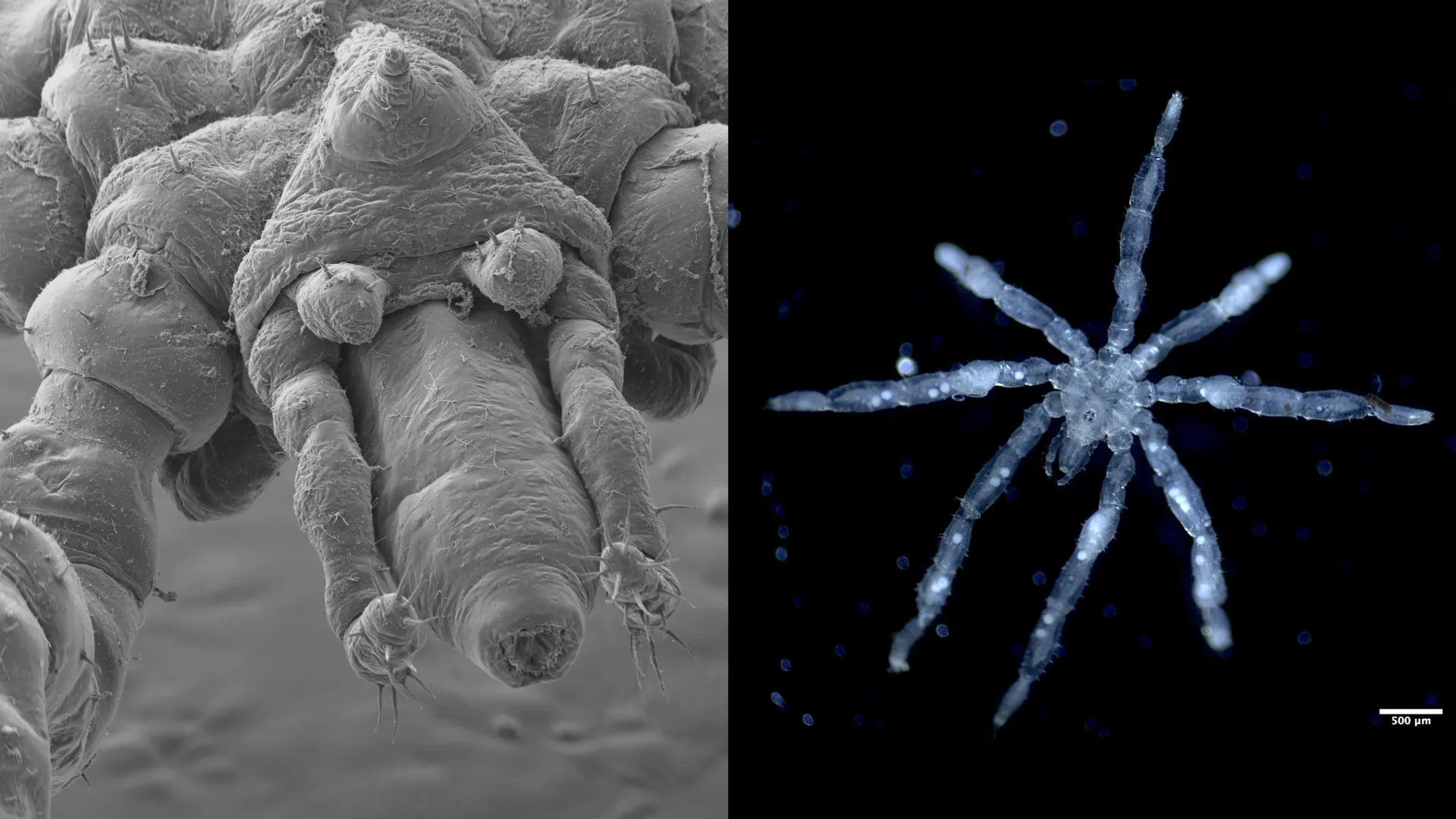
One of the newly identified species has been named Callipallene pilosuspedes, a name referring to the long, curved spines covering the lower parts of its legs.
The species has distinctive red eyes and a short proboscis, a tube-like mouth structure used for feeding. Researchers also observed that its specialised appendages, known as ovigers, have another unusual function.
Under a microscope, scientists saw the animal use these appendages to wrap around its legs and clean its body using comb-like spines.
Only one specimen of Callipallene pilosuspedes was found during the research, making further observations important for understanding the species.
The second species, Tanystylum kiixin, was named after an Indigenous village site near where the animals were first collected. Researchers found that these sea spiders often had dirt and debris attached to their bodies, along with tiny parasites.
Scientists said the species appears to have less flexible egg-carrying appendages, which may limit its ability to groom itself.
Sea spiders are ancient marine arthropods related to spiders, scorpions and horseshoe crabs.
Despite their name, they are not true spiders. Some species can have as many as 12 legs, while their sizes range from less than a centimetre to more than 70 centimetres in some Antarctic species.
They also have unusual biology. Sea spiders breathe directly through their skin, while males carry and care for developing eggs.
The researchers generated DNA sequences for several sea spider species and produced an identification guide for species found in the Salish Sea.
Lead researcher Cormac Toler-Scott said the region likely contains additional species that have not yet been documented, highlighting how much remains to be discovered in its marine ecosystems.
Source : https://new.igihe.com/english/scientists-discover-two-strange-new-sea-spider-species-in-salish-sea/
