

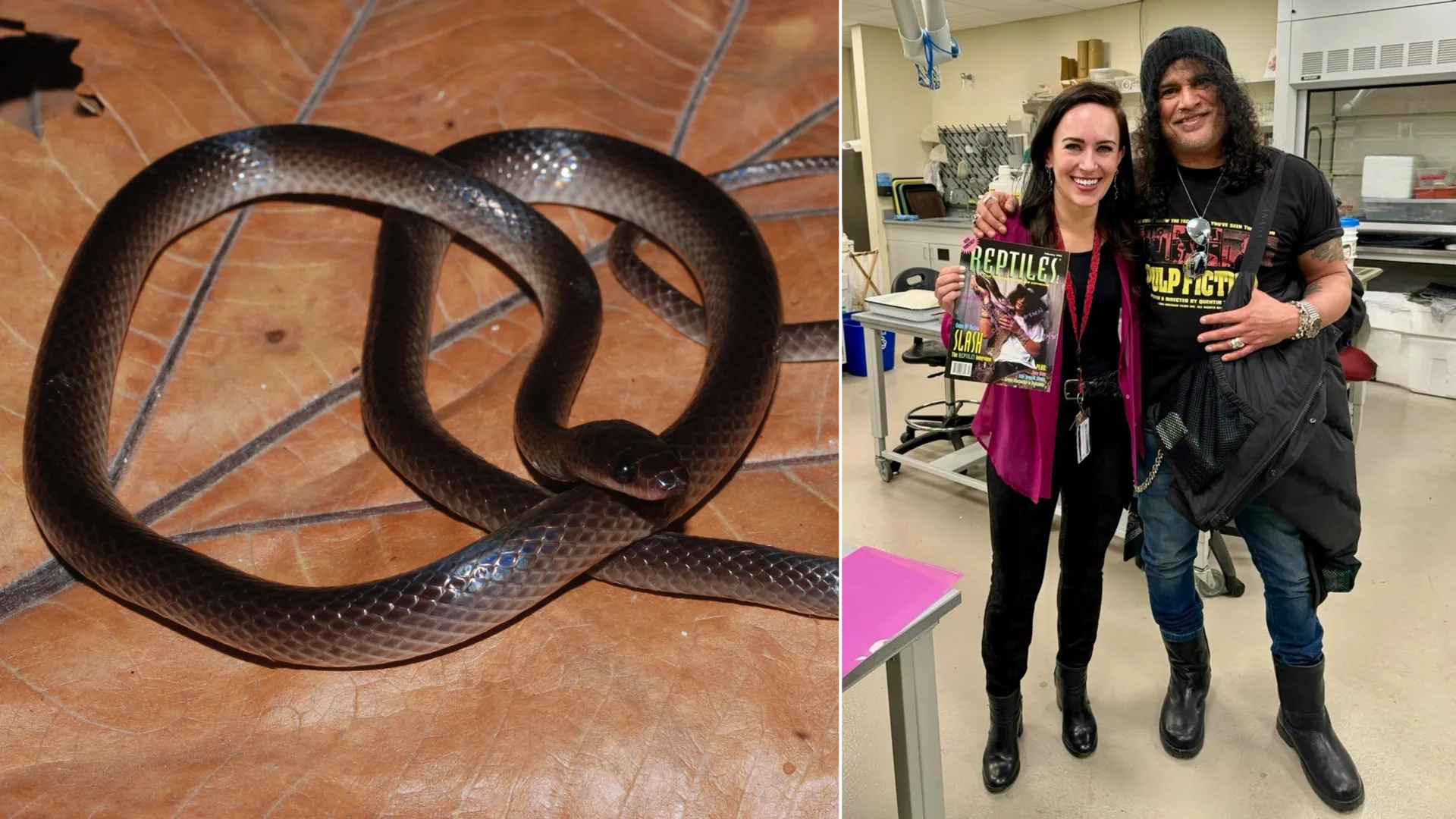
The snake has been given the scientific name Lielaphis slashi, or Slash's groundsnake.
Researchers identified it as a distinct species after combining genetic analysis, physical characteristics and information about its habitat.
The discovery was described in a study published in the scientific journal Zootaxa.
Researchers from the Field Museum and Louisiana State University were involved in the work.
Slash, whose real name is Saul Hudson, has been interested in reptiles since childhood.
He has also supported zoos, museums and natural history organisations, making him a fitting namesake for the newly recognised species.
The connection between Slash and the researchers goes back decades.
Sara Ruane, an associate curator of herpetology at the Field Museum and a senior author of the study, said she became interested in reptiles and Slash while growing up.
Ruane recalled seeing a photograph of Slash holding a pet reticulated python on the cover of Reptiles Magazine.
She later learned about his interest in snakes and natural history.
When researchers had the opportunity to name the previously unrecognized snake, Ruane proposed honoring the guitarist.
The snake was first encountered during fieldwork in New Guinea in 2006 by Chris Austin, a professor and curator of herpetology at Louisiana State University's Museum of Natural Science.
The reddish-brown snake grows to about 28 inches (71 centimetres) long. For years, scientists were uncertain whether it represented an already known species or one that had not yet been formally described.
Genetic testing eventually showed that the snake was distinct from related species.
Researchers also identified differences in its physical characteristics, including the number of scales on its body.
Ecological modelling further showed that it occupies a different habitat from closely related snakes.
Scientists know relatively little about the behaviour of Lielaphis slashi because the species is difficult to observe in the wild.
Like other New Guinea groundsnakes, it is primarily active at night and can be found around the bases of large trees.
Researchers believe its diet may include small lizards and reptile eggs. Its relatively large rear teeth may help it capture slippery prey.
The species is nonvenomous and not considered dangerous to humans.
Scientists say identifying and formally describing species is important for conservation, particularly in regions such as New Guinea, where forests face increasing pressure from activities including agriculture and mining.
The researchers hope that recognising Lielaphis slashi will contribute to greater knowledge of New Guinea's biodiversity and the need to protect its habitats.
Source : https://new.igihe.com/english/new-snake-species-named-after-guns-n-roses-guitarist-slash/
