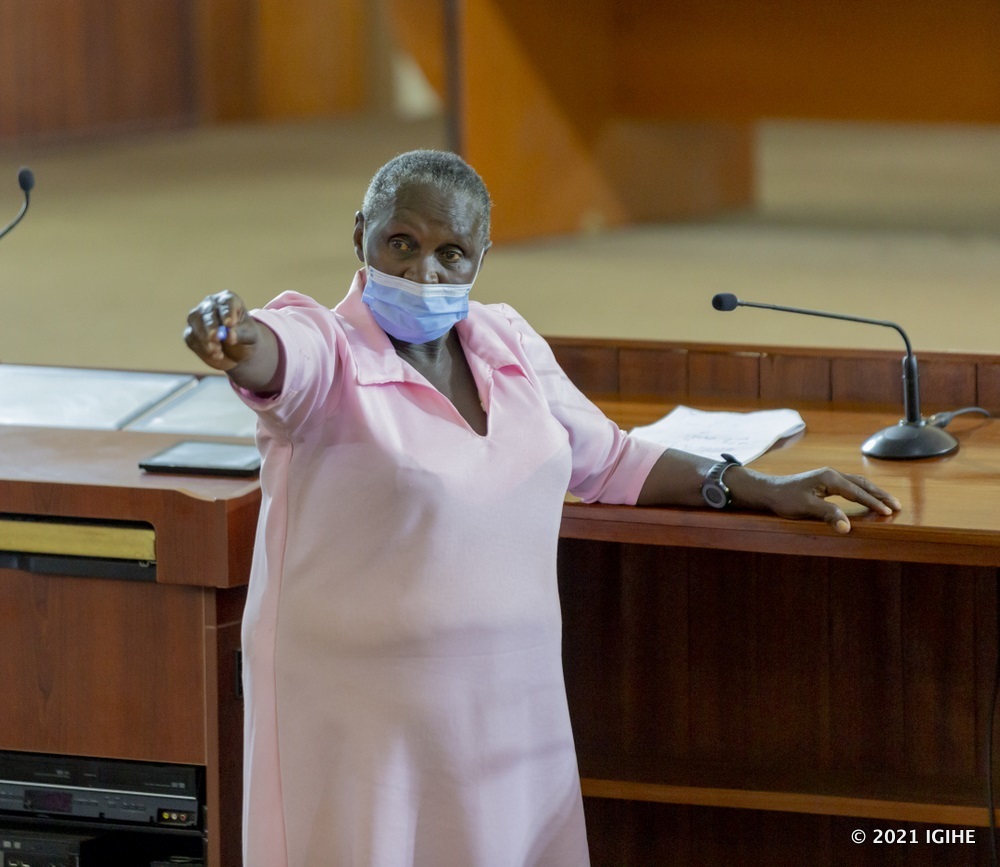

Among those they have identified as playing a role in enforcing these practices is Mukandutiye Angelina, a former senior FDLR figure who, according to their accounts, was responsible for monitoring the lives of women and girls within the group.
The testimonies have come from Rwandan women who were abducted by the FDLR and taken to its bases in eastern Democratic Republic of Congo. Some later escaped or returned to Rwanda and underwent reintegration programmes at the Mutobo Demobilisation and Reintegration Centre in Musanze District.
Retired Corporal Mujawayesu Laurence, who was abducted in 1997 at the age of 14, said women in the group were not expected to become pregnant.
'When a girl became pregnant, she was either killed or forced to terminate the pregnancy,' she said. 'Many girls died because they refused to let men sexually assault them.'
Mujawayesu, who escaped the FDLR in 2003, also alleged that women who resisted forced abortions were subjected to extreme violence.
'There were those who died because they refused to have their pregnancies terminated. They were shot, while others were cut open with knives in front of others as a warning,' she said.
Another former FDLR member, identified as Mutesi (not real name), said women who became pregnant were subjected to forced abortions.
'They did not allow us to become pregnant. If you became pregnant, they would cut you open while you were still alive, remove the baby and kill it separately,' she said.
Umwali (name changed), a 27-year-old Rwandan woman who was born in Walikale, said she herself became pregnant while under FDLR control. She said she was involved in intelligence activities and was therefore expected to remain available for missions.
'Mukandutiye Angelina was the one who gave us the pills to terminate pregnancies because no soldier was supposed to work while pregnant or carrying a child,' Umwali said.
She said the man who had impregnated her was subsequently killed.
Umulisa, 36, another former FDLR member, said Mukandutiye was responsible for monitoring the welfare of women and girls, including their use of contraceptives.
'She told us that we were not supposed to give birth in Congo because it was not allowed,' Umulisa said.
Umulisa said Mukandutiye downplayed the sexual abuse by presenting it as a normal obligation that women and girls were expected to accept from men.
'She did not call it sexual abuse. She said it was something a woman was expected to accept from men,' Umulisa said.
Former members also accused Mukandutiye of selecting some girls and taking them to senior male members of the group, after which she would ensure they used contraceptives.
Mukandutiye's involvement with armed groups in eastern Congo came after she fled Rwanda in 1994. Before that, she had worked as a teacher and served as an education inspector in Nyarugenge, Kigali, from 1986 to 1994.
After joining the FDLR, she became one of its senior figures. Between 2016 and 2017, following a split within the group, she joined the CNRD-Ubwiyunge led by Wilson Irategeka, where she served as development commissioner.
She and other members of the group were later captured in South Kivu and transferred to Rwanda in 2019.
Mukandutiye had already been sentenced in absentia to life imprisonment by Gacaca courts in 2008 for her role in the 1994 Genocide against the Tutsi.
Following her return to Rwanda, she was also prosecuted in a terrorism case involving 21 defendants, including Nsabimana Callixte, known as Sankara, and Paul Rusesabagina, over attacks attributed to the MRCD/FLN.
In 2021, the Kigali High Court sentenced her to five years in prison in that case. The Court of Appeal increased the sentence to 20 years in April 2022.