
The conference, titled 'Belgium's Colonial Injustice and the 101-Year Path to Reparations,' was held on August 21 and organized by the Baku Initiative Group (BIG).
The discussions took place on August 21 during a conference titled 'Belgium's Colonial Injustice and the 101-Year Path to Reparations,' organized by the Baku Initiative Group (BIG).
The meeting brought together representatives of Rwanda, Burundi, the DRC, Morocco and South Africa, alongside UN Human Rights Council experts, diplomats, parliamentarians, human rights advocates, historians and international law experts.
Rwanda was represented by Lt Gen (Rtd) Charles Kayonga, the country's ambassador to Türkiye, who also represents Rwanda in Azerbaijan, Kazakhstan and Lebanon.
Participants examined the historical, political, economic and social consequences of Belgian colonial rule and discussed whether its legacy continues to shape the region. They also considered the restoration of historical justice, reparations and the return of cultural heritage taken from Central Africa during the colonial period.
A colonial legacy across the Great Lakes
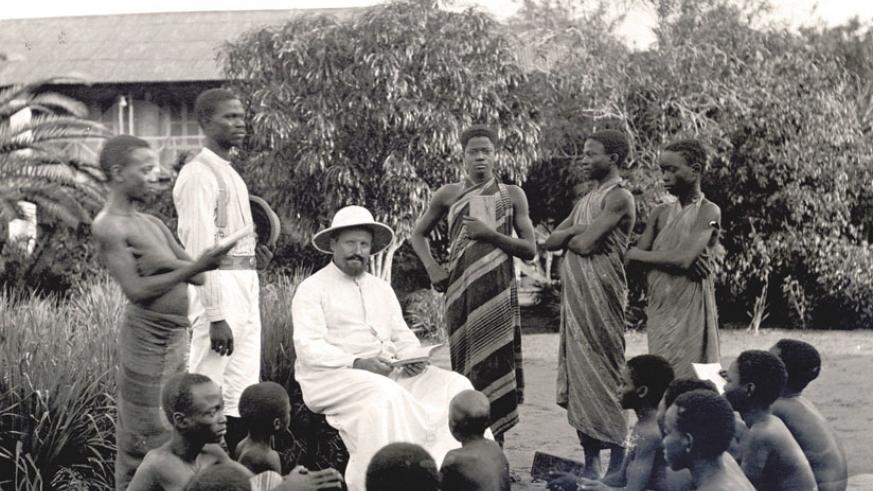
Rwanda, Burundi and the DRC came under Belgian colonial rule in the aftermath of the First World War. Belgian administration of Ruanda-Urundi, which comprised present-day Rwanda and Burundi, began in 1916 after Germany lost control of the territory.
The Belgian colonial period formally ended as the countries gained independence between 1960 and 1962, but participants at the Baku conference argued that its effects have continued to be reflected in political, economic and social structures.
In Rwanda, the country had first been placed under German rule in the late 19th century, following the European partition of Africa associated with the Berlin Conference of 1884–1885.
Belgian rule later introduced policies that placed particular emphasis on economic production for colonial interests, including export-oriented agriculture and compulsory labour.
The colonial administration also played a significant role in reshaping Rwanda's social and political structures. One of the most contested aspects of this period was the way Belgian authorities classified Rwandans along ethnic lines and institutionalized those classifications through identity documents.
Those policies contributed to the entrenchment of divisions that later continued under successive post-independence governments.
The colonial legacy remains a subject of debate in Rwanda, particularly because of the way policies introduced during the Belgian period were later maintained and adapted by governments after independence.
Rwanda became independent on July 1, 1962, while Belgian influence remained present during the early years of the new state.
The political divisions that had been reinforced during the colonial period continued into the First and Second Republics and formed part of the broader historical context preceding the 1994 Genocide against the Tutsi.
Calls for historical justice
At the Baku conference, BIG Executive Director Abbas Abbasov said addressing colonial crimes should go beyond financial compensation.
He called for recognition of historical responsibility, official apologies, reparations and legal safeguards, noting that the DRC, Rwanda and Burundi have long awaited concrete action.
Abbasov said reparations should be pursued transparently and in accordance with international law.
Rwanda's Ambassador Charles Kayonga said colonialism had left a lasting legacy that continues to affect former colonies.
He underscored the need to address that legacy in discussions on responsibility and reparations.
Participants also discussed the appropriation and restitution of cultural heritage from the colonial period, noting that Belgium's Royal Museum for Central Africa holds around 85,000 objects from Central Africa.
The conference further highlighted the five forms of reparation set out in UN General Assembly Resolution 60/147: restitution, compensation, rehabilitation, satisfaction and guarantees of non-repetition.
The discussions come as debates continue across Africa over the historical consequences of slavery and colonialism, with countries and organizations increasingly examining how historical injustices can be addressed through recognition, restitution and reparations.
Participants at the Baku conference called for greater international recognition of colonial-era injustices, stronger legal mechanisms and more systematic discussions on reparations.
They stressed that restoring historical justice is important not only for addressing the past, but also for building a fairer international system for future generations.