

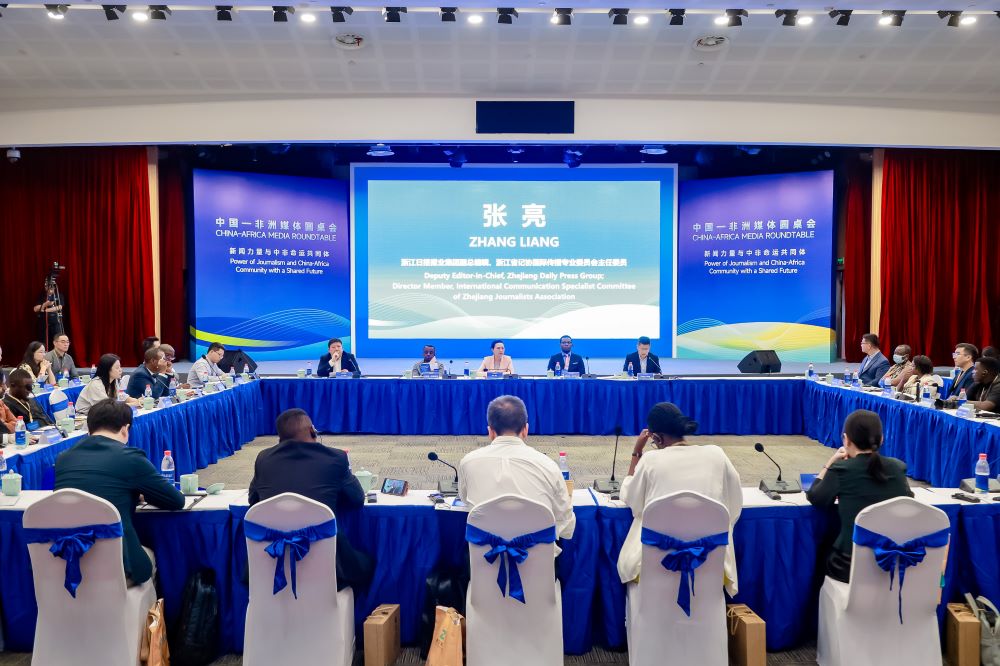
That question was at the heart of a recent roundtable held in Hangzhou, China's Zhejiang Province, where journalists from Rwanda and Ethiopia joined Chinese media professionals and researchers to discuss the future of journalism and China–Africa cooperation in an AI-driven world.
Organized by the All-China Journalists Association under the theme 'The Power of Journalism and the China–Africa Community with a Shared Future,' the discussions focused on a growing challenge facing both media and technology sectors; ensuring that artificial intelligence reflects the realities of Africa and China rather than reproducing incomplete or externally shaped narratives.
While participants touched on broader China–Africa cooperation, including trade and economic ties, the conversation quickly turned to a different kind of exchange—one involving data, knowledge, and representation.
This year marks a significant milestone in relations between China and Africa. Over the past decades, the partnership has demonstrated that sustainable development is not built on charity, but on mutual respect and equal cooperation.
Zhang Qiaowen, Deputy Director of the Institute of African Studies at Zhejiang Normal University, briefly highlighted the depth of China–Africa engagement, noting that Zhejiang accounts for around a quarter of China's trade with Africa and hosts thousands of businesses involved in Africa-related commerce.
Under the framework of the Forum on China–Africa Cooperation (FOCAC), economic ties have evolved from a focus on aid and basic infrastructure to a more balanced model driven by trade and investment.
Trade between China and Africa has grown dramatically, rising from US$10 billion in 2000 to nearly US$350 billion today. Since 2009, China has remained Africa's largest trading partner for 16 consecutive years and has also become one of the continent's fastest-growing sources of investment, even as the global economy faces a growing wave of protectionism.
However, she stressed that the next stage of cooperation is not only about trade volumes but also about how African realities are understood and communicated.
'These are the real stories waiting to be told,' Zhang said, referring to the experiences of African businesses, farmers, entrepreneurs, and communities navigating a rapidly changing global environment.
From trade partnership to knowledge partnership
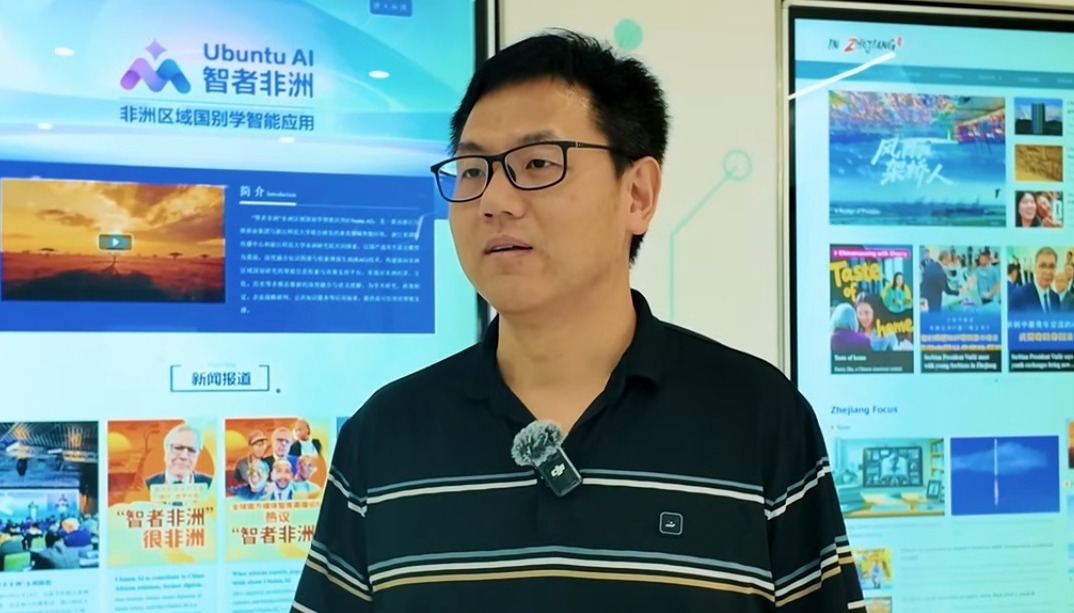
That concern forms the foundation of Ubuntu AI, a platform introduced during the discussions as a new tool designed to improve how Africa-related knowledge is collected, interpreted, and shared.
Developed jointly by the Zhejiang International Communication Center (ZICC), Zhejiang Normal University's Institute of African Studies, and other partners, Ubuntu AI is described as China's first intelligent application dedicated to African studies and China–Africa knowledge exchange.
According to Yang Jidong, Director of the Converged Media Innovation Hub at Zhejiang Daily Press Group, the project emerged from a recognition that many existing large AI models are trained predominantly on Western datasets and information systems.
'The core point of this smart application is that many big models today are based on traditional or Western database training,' Yang explained.
Ubuntu AI seeks to address that imbalance by building a knowledge base rooted more directly in African realities, cultures, research, and experiences.
'The main purpose of Ubuntu is to train local African-related cultures,' Yang said, adding that the platform is designed to ensure that 'our database can represent local African cultures.'
Unlike general-purpose AI systems that pull information from vast and often inconsistent online sources, Ubuntu AI relies on what Yang described as a 'clean and authoritative database' specifically curated around African studies.
'Ubuntu AI is very different from traditional big models because big models are more susceptible to AI hallucinations,' he said.
AI hallucinations refer to instances where artificial intelligence systems generate information that appears credible but is inaccurate or entirely fabricated.
According to Yang, Ubuntu AI addresses this challenge through its underlying architecture, which combines specialized databases with Retrieval-Augmented Generation (RAG) technology. Rather than generating responses solely from a model's internal training, the system first retrieves verified information from its knowledge base before producing an answer.
'This allows me to search for the information I want to understand from my clean database and then generate the corresponding answer through big models,' Yang explained.
For journalists covering Africa, he believes the implications are significant.
'When journalists are collecting data, they can get very authoritative and core information, which can help the media produce content,' he said.
Building an AI model rooted in African realities
The platform supports multiple languages and draws from a wide range of sources, including academic research, media archives, and policy materials. Its goal is not simply to provide information, but to improve context and accuracy in reporting and research.
For African journalists in particular, the initiative raises the prospect of having AI tools that better reflect local realities rather than relying exclusively on datasets developed elsewhere.
Yang argued that Ubuntu AI's greatest strength lies not in the technology itself but in the quality of the knowledge that powers it.
'I think the core of Ubuntu AI is its database,' he said. 'With the expansion of the database, Ubuntu's ability will become stronger.'
He also emphasized that the project's long-term success will depend on collaboration.
'I hope that Chinese research institutions, local African media, and database research institutions can work together to build this database,' Yang said.
Why Ubuntu AI could matter for the future of journalism
That vision aligns closely with the philosophy behind the platform's name. Derived from the African concept of Ubuntu—often translated as 'I am because we are'—the system is intended to function as a shared knowledge ecosystem rather than a one-sided technological product.
Participants at the roundtable repeatedly emphasized that despite advances in AI, journalism remains fundamentally a human profession.
Technology can assist with research, translation, analysis, and content production, but journalists remain responsible for verification, context, and ethical judgment.
As artificial intelligence becomes increasingly embedded in global information systems, initiatives such as Ubuntu AI reflect a growing effort to ensure that Africa is not merely represented in those systems but actively helps shape them.
For both Africa and China, the challenge ahead is not simply building smarter technologies. It is building technologies that understand people, cultures, and societies on their own terms.
And in an era where algorithms increasingly influence how the world sees itself, that may be one of the most important stories of all.
